UK Salary Percentile Calculator 2026/27
Find your UK salary percentile for 2026/27 in seconds. Enter your gross annual salary or hourly rate, then add any extra taxable income, to see where your total income ranks from the top 0.1% to 50% of UK earners. Includes take-home context after Income Tax and National Insurance, updated for 2026/27 UK tax and NI assumptions.
Quick salary rank check: enter your income and see your UK percentile, top-earner band and estimated take-home pay in one clean result.
Where do you sit in the UK income distribution?
Use total individual income before tax. Add salary, self-employed profit, taxable pension, bonuses, rental profit or other taxable income.
Your income percentile
Based on your total individual gross income before tax.
- Income compared
- Compare your job
- Your next step
NEXT: YOUR FREE JOB COMPARISON
How does £35,000 compare with others doing your job?
Your UK rank is one perspective. See what published figures show for your job — free, with no email needed.
Choose the closest match to your day-to-day work.
Use £35,000 for this comparison?
Use pay from this employee job, before tax. Exclude extra income, business profit and owner drawings.
Use a different salary
Which working pattern should we compare?
YOUR NEXT MOVE
What could support your next pay step?
Your comparison is a starting point. Consider the options for your next move.
- Build
Identify results or responsibilities that support progression.
- Ask
Ask what the next pay step requires and when to review it.
- Explore
Compare roles if progression is limited.
YOUR PAY RISE BLUEPRINT
Your pay analysis, suggested next step and conversation plan—with evidence to bring and words to use.
See what your £12.99 includes
Example ASK Blueprint using sample details. Your report may suggest building your case, asking for more or exploring other roles. Pay positions are estimates and depend on the published data.
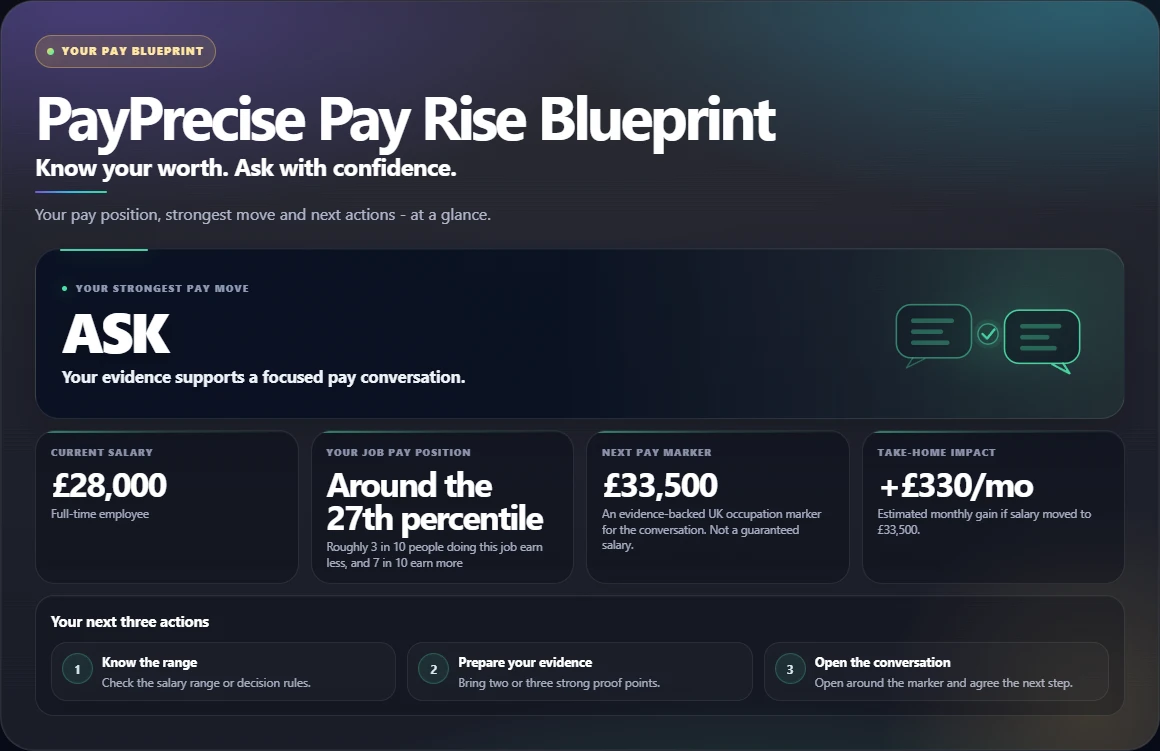
Tap the image to enlarge. These are example figures, not your personal result.
Useful whichever next step the evidence supports
Your report may recommend asking, building your case or exploring. See complete examples using fictional details.
Full personalised Pay Rise Blueprint: £12.99 once
Continue with your free report
See how your pay compares by age and work region. This is a separate comparison, not an occupation pay target.
UK salary percentile calculator: the quick answer
This page tells you where a gross annual salary ranks against the UK income distribution, without making you cross-reference raw percentile tables. Enter a figure and you get the approximate percentile, the nearest named benchmark, and the take-home context — all on the same screen.
The calculator uses HMRC SPI 2023/24 for the main taxpayer income cut-points. The top 0.5% and top 0.1% markers are guide anchors informed by historic IFS analysis and internal interpolation, so they should be read as approximate context rather than official HMRC percentile thresholds. The calculator applies 2026/27 UK Income Tax and National Insurance assumptions to the take-home side.
What your percentile actually means
A percentile rank tells you what share of comparable incomes fall below yours. If the result shows the 75th percentile, roughly three quarters of UK taxpayer incomes are lower. The calculator also expresses this the other way — as a "top X%" band — because that is the framing most people find easier to use in a conversation about pay.
Three things to keep in mind about what the number represents:
It's individual income, not household. A couple each earning £40,000 are both sitting around the 65th–70th percentile individually, even though their household brings in £80,000. UK tax is applied to individuals, not households, so an individual benchmark is the right one for most PAYE and self-assessment questions.
It's before tax, not take-home. The thresholds are gross annual pay. Because the UK's marginal rates rise with income, higher percentiles lose a bigger share to HMRC. Someone at the top 1% threshold (£207,000) keeps roughly 60% after Income Tax and NI; someone at the median (£29,700) keeps about 84% before pension or student loan deductions. Use the calculator output for the take-home number.
It's taxpayers only. HMRC's percentile tables exclude people with no Income Tax liability. That's why the HMRC median here (£29,700) looks different from the ONS ASHE figure many people know — ASHE's 2025 full-time median was around £39,000, but that sample is full-time employees only. Neither number is wrong; they answer different questions. This page uses the HMRC series because it maps directly to the tax bands that determine take-home pay.
Why the thresholds feel higher than they look
The nominal median taxpayer income has more than doubled since the early 1990s — from about £13,000 in 1992/93 to £29,700 in 2023/24. The top 1% threshold has moved from £62,800 to £207,000 over the same period. In real terms, though, the picture is much flatter. ONS analysis suggests real wages have grown roughly 16% over the past 25 years while average UK house prices have risen by over 250%. That's the gap most people feel when they compare their percentile to what they can actually afford.
Real earnings stagnated for most of the 2010s, then fell between 2021 and 2023 as inflation overtook wage growth, and only returned to positive territory in 2024. The most recent ONS release (November 2025 to January 2026) shows nominal regular pay up 3.8%, which is real growth of just +0.4% CPIH — a recovery, but a slow one.
The second factor is fiscal drag. The Personal Allowance (£12,570), higher-rate threshold (£50,270) and additional-rate threshold (£125,140) are due to remain frozen until April 2031 following Budget 2025 measures.
The OBR estimates that threshold freezes and extensions will bring 5.2 million additional individuals into Income Tax, move 4.8 million more into the higher-rate band, and 600,000 more into the additional-rate band by 2030/31.
In practice, that means two things for your percentile reading: (1) the raw thresholds on this page are the correct live numbers, but they understate how much real-terms purchasing power each band represents compared to a decade ago; and (2) the effective tax rate at any given percentile has quietly risen even though headline rates haven't changed. The share of taxpayers paying the higher or additional rate is forecast to rise from 15% in 2021 to around 24% by 2030/31 (OBR).
Using this page well
The percentile rank is most useful when benchmarking a job offer, preparing for a pay review, or sense-checking a market rate. It works best alongside the take-home figure — a percentile tells you where gross pay sits in the distribution, but the calculator's tax breakdown tells you what the position is worth in your pocket under 2026/27 rules.
It's less useful for household or joint-finance decisions (use household-income sources from the ONS instead), for legal or benefits-related thresholds, or as a precise ranking to the exact pound. The HMRC benchmarks are rounded, refreshed annually, and based on taxpayers — not the full adult population.
If you want to go further, open a dedicated threshold page — top 50%, top 25%, top 10%, top 5%, top 3%, top 2% or top 1% — for a full breakdown of what that band looks like after tax, NI, and the marginal rate quirks that cluster around £50,270, £100,000 and £125,140. Above that, the rail also shows guide markers for the top 0.5% and top 0.1%. These are approximate context points informed by historic IFS analysis and internal interpolation rather than official HMRC percentile thresholds.
Percentiles describe people; occupation medians tell a different story
Across 382 four-digit occupations with a published full-time median, 56 have a median of £50,000 or more, 11 reach £70,000 or more, and none reaches £100,000. This is useful context when a percentile result looks high: senior individuals can earn far above the typical pay of their profession.

Source: PayPrecise analysis of ONS ASHE 2025 provisional occupation data. Methodology and assumptions.
Go deeper on a specific threshold
Use the calculator above for your overall rank, then open a dedicated threshold page for a full breakdown of what it means to sit at that level.
UK income benchmark table
Use this as a quick guide to the rounded HMRC-led benchmark points used on this page.
| Percentile point | Approx income | What it means |
|---|---|---|
| Taxpayer midpoint / 50th percentile | £29,700 | Halfway up the HMRC taxpayer income range. |
| 75th percentile / top 25% | £45,000 | Higher than about three quarters of comparable incomes. |
| 80th percentile / top 20% | £50,000 | Into the top 20% of individual UK incomes. |
| 90th percentile / top 10% | £67,400 | A strong upper-income benchmark. |
| 95th percentile / top 5% | £93,600 | Well above most taxpayer incomes. |
| 97th percentile / top 3% | £120,000 | Approximate rounded high-income benchmark. |
| 98th percentile / top 2% | £150,000 | Approximate rounded upper-income benchmark. |
| 99th percentile / top 1% | £207,000 | An unusually high income level. |
| 99.5th percentile / top 0.5% | £300,000 | Approximate guide anchor informed by historic IFS analysis and internal interpolation. |
| 99.9th percentile / top 0.1% | £800,000 | Approximate upper-end guide anchor rather than an official HMRC percentile threshold. |
The figures on this page follow the HMRC taxpayer-income approach — treat them as practical reference points rather than definitive ranks.
What does my UK salary percentile actually mean?▼
A percentile rank tells you what share of comparable incomes fall below yours. If the result shows the 75th percentile, roughly three quarters of UK taxpayer incomes are lower. The calculator expresses this as a “top X%” band — which most people find easier in a pay conversation. The figures are individual gross income before tax, drawn from HMRC’s Survey of Personal Incomes, and exclude people with no Income Tax liability.
Why do the UK salary percentile thresholds feel higher than they look?▼
Two factors drive the gap. First, real wage growth has been slow — ONS data for November 2025 to January 2026 shows nominal pay up 3.8% but real growth of just +0.4% CPIH after inflation. Second, fiscal drag: the Personal Allowance (£12,570), higher-rate threshold (£50,270) and additional-rate threshold (£125,140) are due to remain frozen until April 2031 following Budget 2025 measures. The OBR estimates that threshold freezes and extensions will bring 5.2 million additional individuals into Income Tax, move 4.8 million more into the higher-rate band, and 600,000 more into the additional-rate band by 2030/31.
Why is the median salary on this calculator £29,700 and not the £39,000 UK median salary figure?▼
Both figures are correct but measure different populations. The £39,039 figure from ONS ASHE covers full-time employees only. The £29,700 figure used here is the HMRC taxpayer income midpoint for 2023/24, covering everyone who paid Income Tax — full-time, part-time, self-employed and people taking taxable pensions. Including lower-earning groups pulls the HMRC taxpayer income median below the ASHE full-time median. This calculator uses the HMRC series because it maps directly to the tax bands that determine take-home pay.
What is the top 10% salary threshold in the UK for 2026/27?▼
The top 10% salary threshold in the UK is approximately £67,400 gross annual income before tax, based on HMRC’s Survey of Personal Incomes for 2023/24, published 29 April 2026. This represents the 90th percentile of individual UK taxpayer incomes. The calculator uses 2026/27 Income Tax and National Insurance assumptions to show the take-home equivalent.
What is the top 1% salary threshold in the UK?▼
The top 1% salary threshold in the UK is approximately £207,000 gross annual income before tax, based on HMRC’s Survey of Personal Incomes for 2023/24. At this income level, the Personal Allowance is fully tapered away and the additional rate of 45% applies above £125,140, meaning someone at this threshold keeps roughly 60% of their income after Income Tax and National Insurance.
| Primary source | How PayPrecise uses it | Link |
|---|---|---|
| HMRC percentile points for total income before and after tax (2023/24 release) | Anchor source for median, top-decile and top-1% taxpayer-income benchmarks and the percentile ladder used on this page. | View source |
| HMRC Personal Incomes Statistics commentary 2023/24 | Context on the Survey of Personal Incomes methodology and year-on-year movement in median and top-percentile income. | View source |
| Income Tax rates and allowances (2026 to 2027) | Used for current UK and Scottish tax bands shown in calculator outputs. | View source |
| National Insurance rates and categories | Used for employee NI calculations. | View source |
| ONS Average weekly earnings in Great Britain (March 2026 release) | Used for current real-terms and nominal pay growth context in the editorial section. | View source |
| ONS Annual Survey of Hours and Earnings 2025 | Used for salary-context comparisons where employee-earnings medians or regional pay context are relevant. | View source |
| House of Commons Library: Income tax threshold freeze (CBP-9186) | Source for the freeze extension to 2030/31 and the OBR forecast of additional taxpayers pulled into higher and additional rates. | View source |
| House of Commons Library: Fiscal drag explainer (CBP-9687) | Source for fiscal drag mechanics and OBR revenue estimates on the threshold freeze. | View source |
Percentile estimates are rounded comparison outputs. Final payroll numbers still depend on tax codes, salary sacrifice, pension settings, benefits and individual circumstances.